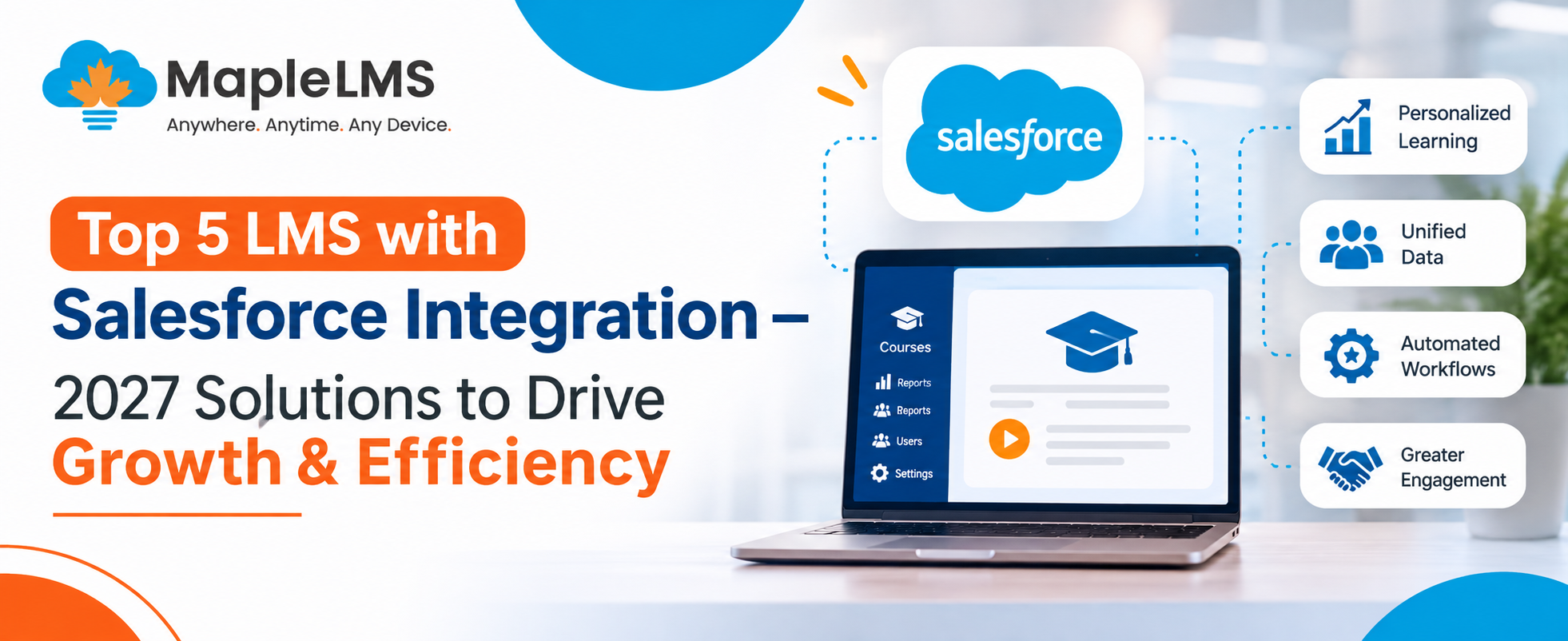
Top 5 LMS with Salesforce Integration – 2027 Solutions to Drive Growth & Efficiency
Combining a Salesforce learning management system with your CRM has become an important step for businesses looking to improve productivity, strengthen employee performance, and simplify training. As organizations prepare for 2027, Salesforce LMS integration will be a top priority to expedite training, guarantee compliance, and provide personalized learning experiences.
Here’s what to look for in an LMS:
- Comprehensive reporting tools for tracking learner data
- Smooth integrations with your other digital tools
- An intuitive, user-friendly interface that works on various devices
- AI-enabled features for content, curation, etc.
- Support for various content types
- The ability to scale with your organization (e.g., handling an increased number of users without drops in performance quality)
- The ability to customize the interface
- Reliable technical support from the software provider
If your organization uses Salesforce as its CRM solution, the best practice is to opt for LMS software that integrates with Salesforce. This should include everything from course creation tools, membership management software, and an AI assistant in a unified platform, ensuring data flows seamlessly to a central database: your CRM.
Why Integrate Your LMS with Salesforce?
Connecting an LMS to Salesforce delivers numerous benefits that enhance productivity and learning effectiveness:
- Unified Platform: Centralize sales and training data for real-time visibility into performance and learning progress.
- Personalized Learning: Tailor courses based on Salesforce data for role-specific training.
- Efficient Onboarding: Automate enrollment for new hires through Salesforce workflows.
- Improved Productivity: Minimize system switching with a single integrated dashboard.
- Continuous Development: Provide easy access to updated training resources for ongoing skill improvement.
What to Look for in an LMS with Salesforce Integration
Use this checklist before you decide:
- Easy, real-time reporting on learner progress
- Smooth connection with Salesforce and your other tools (AMS, HRMS)
- Simple design that works on phones, tablets, and laptops
- AI features that help build and suggest content
- Support for many content types (video, quizzes, live sessions)
- Room to grow as your user count grows
- Branding options to match your look
- 24*7 customer support
Top 5 LMS with Salesforce Integration in 2027
Now that we understand the benefits, let’s explore five Salesforce-related learning solutions.
Each option has a different approach to learning management and Salesforce integration. The best choice depends on your organization’s requirements, audience, and existing technology.
1. MapleLMS
MapleLMS is a 100% Salesforce-native learning management platform. It helps organizations manage employee training, customer education, partner learning, member development, and certification programs through a connected platform. It is also ranked #1 on AgentExchange. Its sophisticated reporting options are one of its main advantages; they enable businesses to monitor training metrics in real time. Sales teams especially benefit from this feature since it gives them information on how training affects sales effectiveness. Additionally, MapleLMS has an extremely adaptable user interface that makes it possible to customize the platform to every company’s own branding and organizational requirements.
Key Features:
- Intelligent real-time reporting to monitor the effect of learning on sales.
- Customizable interface to match company branding for employee training.
- Integration with CRM, AMS, and HRMS systems for smooth learning & training.
- Easy-to-use AI content curation tools for course, quizzes, & assessment creation.
- Supports multiple content formats (videos, quizzes, interactive modules).
- Personalized learning paths using an AI recommendation engine.
- Fully mobile-compatible for learning on the go.
Best for: Associations, nonprofits, and organizations looking for a native Salesforce LMS with connected data, flexible learning programs, and advanced training management.
2. SkyPrep
Another strong LMS that works well with Salesforce is SkyPrep, which has an easy-to-use interface and a number of features designed to enhance learning and growth. SkyPrep’s user-friendly course builder is one of its best features; it makes it simple for administrators to design and oversee training materials. Because it streamlines the content development process and guarantees that all training modules stay up to date and relevant, this feature is especially helpful for organizations that need to update their training materials on a regular basis.
Key Features:
- Intuitive course builder for quick content creation and updates.
- Robust analytics linked to Salesforce for measuring sales impact.
- Gamification elements—badges, leaderboards, rewards—for higher engagement.
- Social learning tools for collaboration and knowledge sharing.
- Custom dashboards for real-time metrics.
Best for: Businesses focused on engaging training with easy administration.
3. Skilljar
A flexible learning management system, Skilljar is designed to provide outstanding training, especially for partner and customer education. Organizations can monitor the complete student journey, from onboarding to certification, thanks to its smooth integration with Salesforce. Scalability is one of Skilljar’s main advantages, which makes it a great option for companies of all sizes. Multiple currencies and languages are supported by the platform, which is crucial for multinational corporations wishing to offer uniform training across borders.
Key Features:
- Designed for customer and partner training.
- Scalable for global organizations (multi-language and multi-currency support).
- Detailed Salesforce-linked analytics to measure ROI.
- Segmentation for targeted content delivery.
- Flexible content options: videos, webinars, interactive modules.
- Mobile-friendly for learners on the move.
Best for: Organizations prioritizing customer education and scalability.
4. Plumlogix
A unified platform for managing training and development is provided by Plumlogix, a complete LMS solution with extensive connectivity with Salesforce. Plumlogix’s adaptive learning technology, which customizes the learning process to each person’s requirements and preferences, is one of its most notable characteristics. Employees’ abilities and performance are improved by this individualized approach, which guarantees that they receive the most pertinent and efficient training. Real-time tracking of training progress and performance is also made possible by the platform’s interaction with Salesforce, which offers insightful data for ongoing development.
Key Features:
- Adaptive learning technology for personalized training.
- Strong content management system supporting multiple formats.
- Analytics connected to Salesforce for performance tracking.
- Collaboration tools—discussion forums, peer reviews, group projects.
- Mobile access and automated workflows for smooth execution.
Best for: Organizations seeking personalized, collaborative learning experiences.
5. HESFP
A powerful training and development management solution is provided by HESFP, a state-of-the-art learning management system that effortlessly connects with Salesforce. HESFP’s emphasis on compliance training is one of its main advantages, which makes it a great option for businesses in highly regulated sectors. With capabilities like certification management, audit-ready reporting, and automated compliance tracking, the platform makes sure businesses can comply with regulations and stay out of trouble. Real-time compliance status tracking is also made possible by Hesfp’s integration with Salesforce, giving businesses the visibility they require to stay in compliance.
Key Features:
- Specializes in compliance training, which is ideal for regulated industries.
- Automated compliance tracking, certification management, and audit-ready reports.
- Advanced gamification to keep learners motivated.
- Supports videos, quizzes, and interactive content for engagement.
- Adaptive learning paths for role-based training.
- Salesforce integration for real-time compliance visibility.
Ideal for: Organizations that need constant monitoring and have stringent compliance standards.
How to Pick the Right Salesforce LMS in 2027?
Selecting an LMS is not just about comparing features. You need a platform that fits your organization’s learning goals, existing systems, and future requirements.
Here are five important factors to consider.
1. Understand Your Training Requirements
Start by identifying who you want to train and what you want to achieve.
For example:
- Staff onboarding and skill development.
- Member learning and continuing professional development.
- Compliance training and certification management.
Choose an LMS that supports your specific learning needs.
2. Check Salesforce Integration Capabilities
Not all LMS integrations work in the same way.
Some platforms connect to Salesforce through APIs or managed packages, while others are built natively on Salesforce.
Before choosing, check whether the LMS supports:
- Two-way data synchronization.
- Automatic learner enrollment.
- Single Sign-On (SSO).
- Course progress and completion updates.
- Certification and credit tracking.
- Custom field mapping.
- Salesforce reporting and dashboards.
Also, understand whether these features are included or require additional configuration.
3. Consider the Learner Experience
A good LMS should make learning simple for everyone.
Look for features such as:
- Easy navigation.
- Mobile learning.
- Personalized learning paths.
- Interactive courses and assessments.
- Multiple content formats.
- Accessibility support.
A simple and engaging learning experience can encourage learners to participate in training programs.
4. Look for Automation and Reporting
Managing training manually can become difficult as your organization grows.
Choose an LMS that automates repetitive tasks such as enrollment, reminders, assessments, and certification tracking.
It should also provide useful reports that help you understand learner progress and training outcomes.
5. Scalability
Your training requirements may change as your organization expands.
The LMS should be flexible enough to support more learners, different training programs, and additional business requirements.
Consider whether the platform offers:
- Flexible user management.
- Multiple learning portals or microsites.
- Custom branding.
- Integration with other business applications.
- Scalable storage and reporting.
- Ongoing technical support.
The right LMS should support your current needs while giving you room to grow.
Future Trends To Watch:
- AI and machine learning for smarter, personalized training.
- Advanced analytics for deeper insights into learner performance.
- Immersive technologies for interactive learning, such as AR and VR.
Conclusion
As we move into 2027, combining LMS with Salesforce continues to be a powerful way to improve learning and business performance. Platforms like MapleLMS, SkyPrep, Skilljar, Plumlogix, and HESFP help businesses deliver personalized, data-driven learning experiences.
In summary, the secret to providing effective training, increasing productivity, and guaranteeing long-term success is using a Salesforce learning management system. In addition to streamlining training, the ideal Salesforce LMS will boost employee and organizational growth, putting you ahead of the competition in a cutthroat industry. To learn more about MapleLMS, a highly rated Salesforce on AgentExchange, get in contact with industry professionals now.
Frequently Asked Questions
Demo