Blog
LMS Migration Project Plan: A Complete Guide with Adaptable Template
Plan your LMS migration step by step: week-by-week project plan, data mapping matrix, UAT checklist, and a multi-region rollout template. Updated 2026.

Learn how a partner training LMS keeps distributors, vendors, customers, and contractors in separate branded portals with isolated reports and certifications.

Plan your LMS migration step by step: week-by-week project plan, data mapping matrix, UAT checklist, and a multi-region rollout template. Updated 2026.
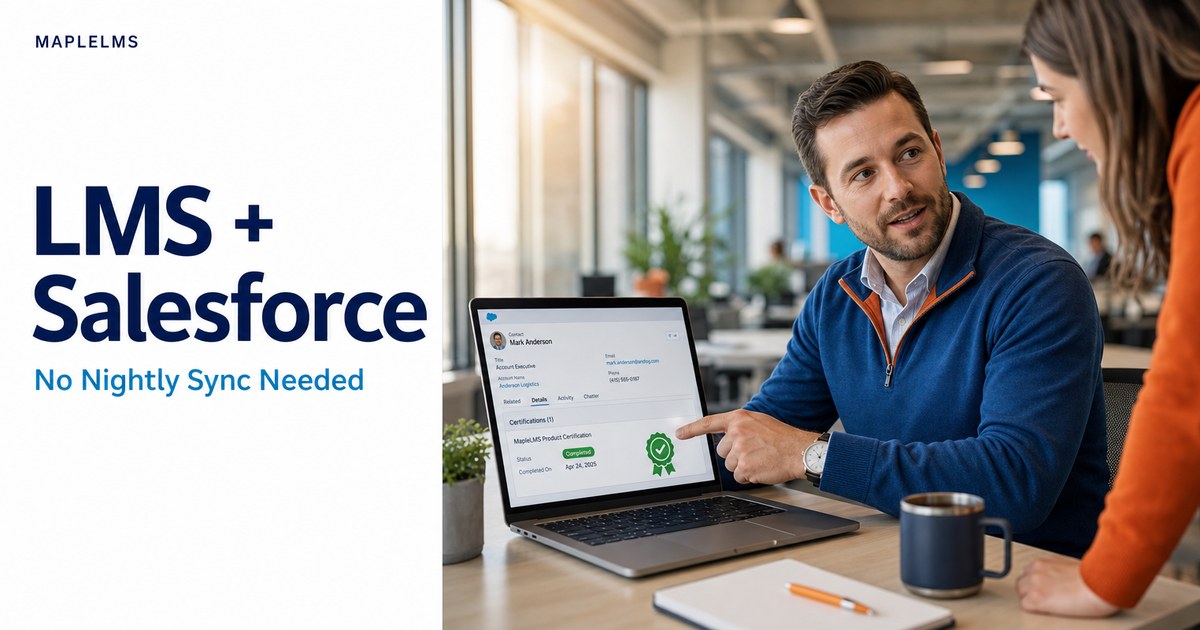
Learn how LMS integration with Salesforce works, which architecture eliminates nightly syncs, and how to evaluate AppExchange LMS apps before you commit.

Learn how retail chains use a Learning Management System to train frontline staff on new products and promotions by location, even with high turnover.
Request a quote and our experts will contact you within 24 hours with tailored solutions and pricing.
You can also send us a quick email at sales@maplelms.com.
MapleLMS
Last updated: Oct 14, 2026
By Surbhi Bhatia, Content Coordinator, MapleLMS Surbhi covers learning technology and extended enterprise training at MapleLMS, with a focus on compliance-regulated industries including life sciences and CPG.
A partner training Learning Management System (LMS) is a platform that trains distributors, contractors, customers, and vendors in branded portals isolated from the employee learning environment, with separate learner records, certifications, and reports for each external audience.
Organisations that expand into new regions and route-to-market models see the external training audience grow fast. Distributors need product certification. Contract sites need compliance training. Healthcare Professionals (HCPs) need onboarding on new therapies. Vendors need your quality standards. None of them should see each other's records, or yours.
This guide explains how a partner training LMS separates learners, content, and reports by audience, which features are non-negotiable, and where the architecture matters most for compliance-sensitive industries.
Key Takeaways
- A partner training LMS runs multiple isolated portals, one per external audience, from a single administrative back-end, so distributors, customers, and vendors each see only their own content and certifications.
- Multitenant microsites let each portal carry its own brand without creating employee accounts for external learners.
- Role-based automated assignment means a distributor in Portugal and a vendor in Texas each get the right training without manual steps.
- Certification tracking is audience-specific: partner certificates live in a separate record from employee certificates, and expiry alerts run independently.
- In life sciences, portal isolation is a compliance requirement: audit reports for external sites must extract without exposing internal employee data.
A partner training Learning Management System (LMS) delivers training to external audiences, such as distributors, contractors, customers, and Healthcare Professionals (HCPs), in portals kept entirely separate from the employee learning environment. Separation matters because each group must see only its assigned content, certifications must track independently, and external data must never appear in internal compliance reports or audit exports. MapleLMS is trusted by 400+ organisations running this model.
MapleLMS data (internal): Trusted by 400+ organisations, MapleLMS has supported migrations of 150,000+ learners in a single deployment, including external user groups across partner and distributor portals. These figures reflect MapleLMS's own customer data.

The concept sits inside what training teams call extended enterprise training, which is the practice of delivering structured learning to everyone outside the payroll: channel partners, third-party distributors, contract research sites, customer contacts, and suppliers. Each group has different content requirements, different compliance obligations, and different reporting needs.
The failure mode without separation is predictable. Administrators add distributors as users in a single LMS environment. Distributor completion data then contaminates employee compliance reports. The alternative, standing up a second LMS instance for external users, doubles administrative overhead. Neither approach scales.
The solution is a platform with multitenant microsite capability: one administrative back-end, multiple isolated portals, each with its own branded login, its own learner directory, its own course catalogue, and its own reporting layer.
| External Audience | Typical Training Need | Why Separation Matters |
|---|---|---|
| Distributors | Product certification, sales methodology | Certification must track by territory without mixing with rep records |
| Contract sites / CROs | Good Practice (GxP), safety protocols, SOPs | Audit reports for external sites must not include internal employee data |
| Customers / HCPs | Product onboarding, therapeutic education | Customer engagement data is commercially sensitive and separate from staff |
| Vendors / suppliers | Quality standards, safety requirements | Vendor compliance status must be reportable independently for audits |
| Contractors | Site-specific compliance, induction | Contractor records must be removable on contract end without touching employee data |
A channel partner Learning Management System (LMS) gives distributors their own login, course catalogue, and certification records inside the same administrative platform as employee training, but logically isolated from it. Administrators run certification reports per audience without mixing distributor completions with employee data. MapleLMS internal data (2025) shows 86% user adoption across approximately 500 internal and external users at CMAX after implementing this architecture.
MapleLMS data (CMAX case study, 2025): 86% user adoption across approximately 500 internal employees and external users at CMAX, an Australian early-phase clinical research organisation. Before implementation, stakeholders had no real-time visibility into learner progress or compliance status across either group.

The architecture that makes this work has three layers.
Each portal keeps its own learner directory. A distributor in the partner portal does not appear in the employee directory, and vice versa. Role-based access controls determine what each learner sees within their portal. When a distribution agreement ends, the administrator deactivates that learner in the partner portal. Nothing in the employee environment changes.
The partner portal shows only the programmes assigned to that distributor's role, region, or product line. A distributor in one territory sees the certification path for their products. A distributor in another territory sees a different path. Neither sees internal onboarding, compliance tracks, or HR-facing content.
Certifications earned in the partner portal live in a separate record set. Expiry dates, renewal reminders, and recertification workflows run independently of the employee certification cycle. Administrators pull a report showing every distributor's certification status by territory, product, or expiry date. That report contains no internal employee records.
After implementing audience-specific certification tracking for 150,000+ learners across North America, Europe, and APAC, MapleLMS internal data (2025) shows certification visibility moved from limited to centralised and training completion rate rose from 68% to 91%.
A partner onboarding LMS with multitenant microsite capability provisions distributor learners in a white-labelled portal with no employee account created in the internal system. Distributors complete onboarding programmes assigned by role or region, and their certifications stay in a separate record set. MapleLMS internal data (2025) shows learner engagement rose 42% and administration effort fell 35% after moving to this model at 150,000+ learner scale.
MapleLMS data (internal, 2025): Learner engagement increased by 42% and LMS administration effort fell by 35% across a 150,000+ learner deployment after implementing multitenant portal architecture. Reporting turnaround moved from 2-3 days to real-time.

A white-labelled distributor portal carries your company's logo, colour scheme, and domain, or the distributor's own brand if the agreement requires it. Distributor learners see a login page that matches their relationship with you. They do not land on a generic LMS screen. They see no reference to your internal training environment.
Inside the portal, each learner sees:
Giving an external learner a portal login does not require creating an employee record. In a Salesforce-Native LMS, external learners are provisioned inside the partner portal using a separate object, not as Salesforce user licences in the core organisational instance. This matters for two reasons: cost (no Salesforce seat for every distributor) and governance (external learner data never mixes with Salesforce HR or commercial data unless deliberately constructed as a report).
When a new distributor onboards, the platform assigns the correct certification path based on role and territory. The administrator does not manually enrol each new distributor. Assignment rules run automatically. This is the difference between onboarding that completes in one day and one that takes two weeks of back-and-forth emails.
A customer onboarding LMS tool built on a multitenant architecture runs a branded customer or Healthcare Professional (HCP) portal from the same administrative back-end as the employee LMS, with no shared content or records between audiences. Customers get assigned onboarding by product or region, and their data feeds customer-facing dashboards, not internal reports. MapleLMS internal data (2025) shows 96% user adoption at Casa Pharma Rx for role-based product training delivered this way.
MapleLMS data (Casa Pharma Rx case study, 2025): 96% user adoption for role-based product training at Casa Pharma Rx, a 503A licensed compounding pharmacy in Stafford, Texas, serving both sales and customer-service teams through a single platform.

Running customer and HCP training from the same platform as employee training creates advantages a separate system cannot replicate.
Your training administrator sees all portals, all audiences, and all completion data from one back-end. When a product update requires a change to the customer onboarding programme, the administrator makes the change once. It propagates to the customer portal without touching the employee programme.
Customers and HCPs are onboarded to a specific product or therapeutic area, not a general catalogue. The platform assigns the onboarding path based on what the customer has purchased or what the HCP is being educated on. This keeps the experience focused and reduces time-to-competency.
In life sciences, customer and HCP training often carries regulatory implications. A platform supporting 21 CFR Part 11 requirements, the US FDA regulation governing electronic records and electronic signatures including audit trails and access controls, can maintain these controls at the portal level. This is subject to the organisation's applicable quality and validation processes. Customer and HCP completion records are exportable independently of employee records for any regulatory review.
| Portal Type | Learner Type | Content Scope | Reporting Output |
|---|---|---|---|
| Employee portal | Internal staff | Full training catalogue | Internal compliance dashboard |
| Customer / HCP portal | Customers, HCPs | Product-specific onboarding | Customer engagement reports |
| Partner portal | Distributors, resellers | Product certification paths | Partner certification by territory |
| Vendor portal | Suppliers, contractors | Quality and safety standards | Vendor compliance by supplier |
A vendor training LMS assigns suppliers to an isolated portal with access only to content relevant to their audit or standards requirements. Vendor records, completions, and certifications are stored separately from employee data, so a vendor audit report never includes staff records. MapleLMS internal data (2025) shows compliance tracking time dropped from 5 days to under 1 day after centralising external and internal training in this architecture.
MapleLMS data (internal, 2025): Compliance tracking time dropped from 5 days to under 1 day after implementing centralised, audience-specific training records for 150,000+ learners, including external user groups such as vendors and contract sites.

Vendors get access only to content they need. A packaging supplier sees your packaging quality standards. A contract logistics provider sees your Environment, Health and Safety (EHS) requirements. Neither group sees product development training, commercial training, or any internally restricted content.
When a vendor's contract ends, the administrator deactivates that vendor's learner account. Completion records remain for audit purposes, but the vendor can no longer access the platform.
Some organisations make vendor certification a condition of procurement: a supplier cannot receive a purchase order until key contacts have completed required quality training. A vendor training LMS supports this by making certification status reportable by supplier, contact, and training type. Procurement teams verify certification before issuing orders, with no manual reconciliation needed.
When an auditor asks for evidence that vendors were trained on quality standards, the vendor portal produces an exportable report by supplier. It shows who completed which training, when, and which version of the content they completed. Because vendor records are isolated, this report requires no manual filtering to remove internal employee data.
A partner training LMS needs five capabilities: multitenant portal isolation, role-based automated assignment, independent certification tracking with expiry notifications, audience-specific audit-ready reporting, and a white-label branding layer. Without all five, administrators manually separate data that should never have mixed. MapleLMS holds a 4.8 out of 5 rating on G2 (2025, 17 reviews, 85.7% mid-market).
That G2 rating reflects real-world use across mid-market organisations managing multiple learner types. The administration effort reduction, 35% fewer hours spent on LMS administration across 150,000+ learners (MapleLMS internal data, 2025), comes directly from automated assignment and centralised reporting, not from cutting corners on isolation.
| Feature | Why It Matters for Partner Training | What Weak Implementation Looks Like |
|---|---|---|
| Multitenant portal isolation | Prevents external learners from seeing employee content or records | Separate LMS instances requiring separate admin logins |
| Role-based automated assignment | Enrols each learner in the right path without manual steps | Administrators manually enrol each partner in each course |
| Independent certification tracking | Partner certificates expire and renew on their own schedule | Certification expiry managed in spreadsheets outside the LMS |
| Audience-specific reporting | Partner audit reports extract without employee data included | Reports require manual filtering before external sharing |
| White-label branding | Each portal reflects the right brand identity for that relationship | All partners land on the same generic LMS homepage |
| Mobile and offline access | Distributors and field contacts often train away from a desk | Training only accessible on a desktop browser |
| Salesforce-native architecture | Partner data sits alongside CRM data without a sync connector | Partner training data lives in a separate database, requiring manual exports |
External audiences need content updated quickly when products, policies, or standards change. A built-in authoring tool means the training team can revise a Sharable Content Object Reference Model (SCORM)-compliant programme and push the updated version to the partner portal without an external vendor. When a product label update requires every distributor to recertify, the team can create and deploy revised training the same day.
Distributors and vendor representatives often complete training away from a desk. An LMS with a native iOS and Android app and full offline capability lets them download a certification path, complete it in the field, and sync progress on reconnect. This matters for route-to-market distributors, field technicians, and contract site staff who rarely sit at a desktop.
A Salesforce-Native Learning Management System runs partner, distributor, and customer portals within Salesforce infrastructure using standard Salesforce objects and permissions, so external learner data never sits in a separate database. Administrators access all audiences from one Salesforce dashboard. MapleLMS internal data (2025) shows reporting turnaround moved from 2-3 days to real-time after implementing this architecture for 150,000+ learners across three regions.
The commercial advantage is specific. When partner certification data and sales pipeline data live in the same Salesforce environment, a commercial leader sees which distributors are certified on which products alongside the revenue those distributors generate. No export, no manual join, no spreadsheet.
Salesforce-Native means the LMS runs entirely within Salesforce infrastructure using standard Salesforce objects, permissions, and authentication. For extended enterprise training, this means:
For the technical evaluator reviewing the architecture, this removes the most common risk with LMS integrations: the possibility that a "native" label conceals a sync connector creating a second database to maintain. MapleLMS is listed on Salesforce AgentExchange as a 100% native managed package.
CMAX, an Australian early-phase clinical research organisation, implemented MapleLMS with a Salesforce integration that synced learner progress, completions, certifications, and records for approximately 500 internal employees and external users (MapleLMS, 2025). Before implementation, stakeholders had no real-time visibility into compliance status across either group. After implementation, certification status was visible in real time, and the organisation reached 86% user adoption across internal and external learners. The platform managed mandatory FDA, Good Clinical Practice (GCP, the international quality standard for clinical trials), and HIPAA training from a single administrative back-end.
A partner training LMS is not the right fit when supplier training must trigger automatically inside the same system managing document control, corrective actions, or SOP releases. That requirement belongs to an electronic Quality Management System with a native training module. A partner training LMS delivers and certifies training; it does not replace document control or CAPA workflows, and it does not supply pre-validated GxP content libraries.
An electronic Quality Management System (eQMS) is software that manages quality processes including document control, corrective and preventive actions (CAPA), and standard operating procedure (SOP) workflows in regulated industries. A partner training LMS and an eQMS serve different jobs.
Specifically, a partner training LMS is not the right primary tool if:
For organisations needing both a training platform and an eQMS, the practical architecture is to integrate them. The eQMS manages document control and triggers retraining events. The LMS delivers training, tracks completion, and maintains the audit trail. MapleLMS supports this pattern via its open API framework.
Pharma companies handle training for external sites and contractors by creating isolated portals inside a Learning Management System, assigning only content relevant to each site or contractor type, and tracking completions and certifications separately from employee records. Access is controlled by role and organisation, so contractors see only what applies to them. Audit-ready reports can be pulled for any external group without exposing internal employee data, supporting regulatory inspections subject to the organisation's applicable quality and validation processes.
A partner training LMS is a Learning Management System configured to serve external audiences, such as distributors, resellers, contractors, or customers, in portals separated from the employee training environment. Unlike a standard employee LMS, it supports multiple branded portals under one admin instance, with separate learner records and certification tracking per audience, and access controls that prevent external users from seeing internal content or data.
Yes. A multitenant Learning Management System runs both employee and partner training from one administrative back-end. Each audience gets its own branded portal with isolated learner records, course catalogues, and reports. Administrators manage all audiences centrally without cross-contaminating data. MapleLMS demonstrated this with approximately 500 internal employees and external users at CMAX, achieving 86% user adoption across both groups (MapleLMS CMAX case study, 2025).
A partner training LMS assigns certifications to external learners based on their role and portal, tracks expiry dates automatically, and sends renewal reminders without administrator intervention. Certification records for partners are stored separately from employee records, so compliance dashboards show each group's status independently. Administrators export partner certification reports for audits without including any internal employee data.
For regulated industries, a partner training LMS should carry SOC 2 Type II certification, ISO 27001, and GDPR compliance at minimum. For life sciences use cases involving Good Practice (GxP) training, the platform should support electronic signatures, immutable audit trails, and version-controlled content redeployment, subject to the organisation's applicable quality and validation processes. MapleLMS holds SOC 2 Type II, ISO 27001, and GDPR compliance, and supports 21 CFR Part 11 requirements, subject to the organisation's applicable quality and validation processes.
The core problem a partner training LMS solves is not a technology problem alone. It is an administration and compliance problem. External learners accumulate in an environment built for employees, records mix, reports become unreliable, and audit preparation becomes a manual rescue project.
The answer is genuine audience isolation. Separate portals carry their own learner directories, course catalogues, certification records, and reporting layers, all managed from one administrative back-end. When that architecture sits inside a Salesforce-Native LMS, partner certification data sits alongside commercial data in Salesforce without an export or a sync delay.
Five outcomes follow from the right architecture:
For broader context on partner training programme design, see the MapleLMS guide to partner training using an LMS. When you are ready to evaluate the architecture for your specific audience mix, the next step is a live demonstration.
Book a Demo with MapleLMS to see multitenant partner portals, audience-isolated reporting, and Salesforce-native certification tracking in a live environment.