Blog
LMS Migration Project Plan: A Complete Guide with Adaptable Template
Plan your LMS migration step by step: week-by-week project plan, data mapping matrix, UAT checklist, and a multi-region rollout template. Updated 2026.

Real examples of how companies use a corporate LMS beyond compliance: onboarding, field readiness, SCORM, cloud delivery, and when your business needs one.
Plan your LMS migration step by step: week-by-week project plan, data mapping matrix, UAT checklist, and a multi-region rollout template. Updated 2026.
Learn how LMS integration with Salesforce works, which architecture eliminates nightly syncs, and how to evaluate AppExchange LMS apps before you commit.

Learn how retail chains use a Learning Management System to train frontline staff on new products and promotions by location, even with high turnover.
Request a quote and our experts will contact you within 24 hours with tailored solutions and pricing.
You can also send us a quick email at sales@maplelms.com.
MapleLMS
Last updated: Oct 15, 2026
By MapleLMS Editorial Team
A corporate Learning Management System (LMS) is a software platform that automates training assignment, completion tracking, and certification renewal across an organisation, used by companies from 500 to 150,000+ learners.
Most articles about learning management system examples stop at compliance training. Compliance is one of eight or ten ways companies use these platforms every day. Whether you are deciding if your organisation needs one, evaluating cloud delivery, or trying to understand what Sharable Content Object Reference Model (SCORM) compliance means for your existing course library, this guide gives you concrete answers grounded in documented deployments.
MapleLMS case study data shows training completion rising from 68% to 91%, compliance tracking falling from 5 days to under 1 day, and reporting moving from 2-3 days to real-time, across 150,000+ learners on three continents. The examples in this guide draw on that case and others to show what a corporate LMS actually does when it is working.
Key Takeaways
- A corporate LMS automates role-based course assignment, completion tracking, certification issuance, renewal reminders, and compliance reporting: capabilities HR software and shared drives do not provide natively.
- MapleLMS Cornerstone migration case study data shows training completion rising from 68% to 91% and compliance tracking time dropping from 5 days to under 1 day in a single life sciences migration covering 150,000+ learners.
- A cloud-based LMS handles hosting, automatic upgrades, security patching, and disaster recovery on the vendor's side; an in-house system leaves every one of those tasks to your IT team.
- SCORM compliance means your existing course library works in a new LMS without rebuilding; xAPI (Experience API) extends tracking to mobile offline completions and on-the-job activities.
- There is no fixed headcount rule for needing an LMS: the signal is operational pain, not a specific number of learners.
- Modern platforms now include private AI for course generation, a Learning Experience Platform (LXP) layer for personalised journeys, and AI proctoring for defensible credentials.
In this guide:
A corporate Learning Management System (LMS) assigns, delivers, tracks, and reports on training by role and region automatically. HR software records employment data; a shared drive stores files. Neither assigns training to specific roles, tracks pass or fail per learner, issues certificates, or alerts managers when a certification is about to expire. In a documented MapleLMS deployment, compliance tracking time fell from 5 days to under 1 day after replacing manual processes.
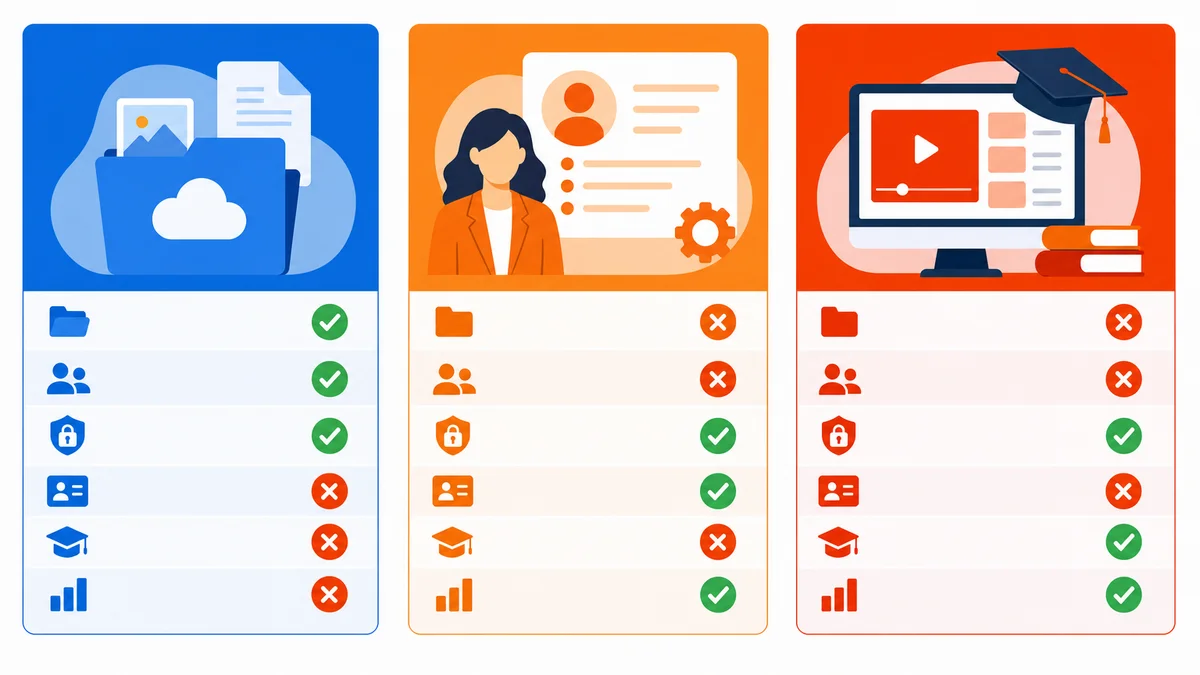
The difference is clearest under audit pressure. Before migrating to MapleLMS, one anonymised life sciences organisation spent 5 days preparing compliance tracking reports before each audit. After migration, that time fell to under 1 day. Reporting turnaround moved from 2-3 days to real-time. Neither outcome is achievable with a shared folder or an HR information system built to track headcount, not course versions, expiry dates, and electronic signatures.
| Capability | Shared drive | HR software | Corporate LMS |
|---|---|---|---|
| Store training files | Yes | Sometimes | Yes |
| Assign courses by role or region automatically | No | No | Yes |
| Track completion and pass/fail per learner | No | No | Yes |
| Issue and renew certifications automatically | No | No | Yes |
| Generate audit-ready compliance reports | No | Limited | Yes |
| Send overdue and expiry alerts | No | No | Yes |
| Deliver SCORM or xAPI content | No | No | Yes |
| Support electronic signatures (21 CFR Part 11) | No | No | Yes |
Most corporate LMS deployments are managed by a small L&D operations team, sometimes a team of one. The platform is designed so that administrators who understand SCORM and learning paths, but are not database engineers, can manage user groups, course libraries, and reporting without routine IT involvement. In a documented MapleLMS deployment of 150,000+ learners across North America, Europe, and APAC, administration effort dropped by 35%. That saving returned directly to the L&D operations team.
A Learning Management System (LMS) for a business automates the full training cycle: role-based course assignment, completion tracking, certification issuance, renewal reminders, and compliance reporting. There is no fixed headcount threshold. The signal is operational pain: onboarding inconsistency across sites, compliance tracking consuming days of manual work, or certification renewals managed in spreadsheets. MapleLMS case study data shows this pain appearing at around 500 learners and persisting at 150,000+ without a dedicated platform.
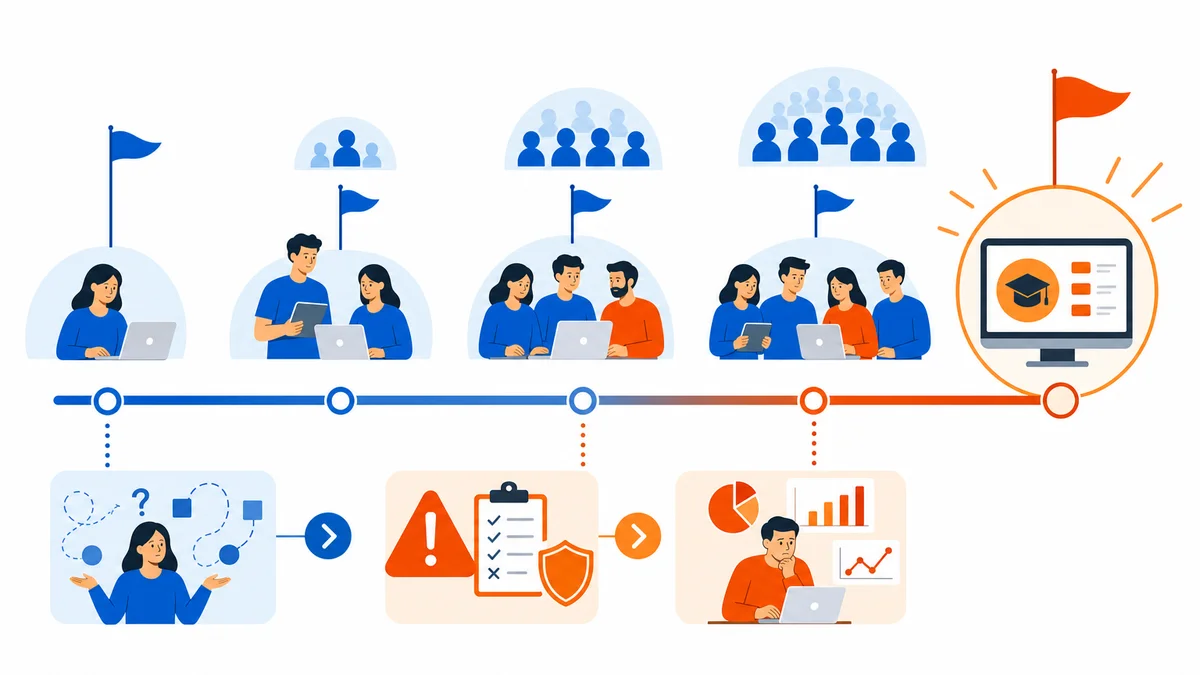
CMAX, an Australian early-phase clinical research organisation, implemented a corporate LMS at approximately 500 learners. It reached 86% user adoption while managing mandatory training for US Food and Drug Administration (FDA), Good Practice (GxP), and Health Insurance Portability and Accountability Act (HIPAA) requirements. At the other end of the scale, a single anonymised life sciences customer migrated 150,000+ learners across three continents. Training completion rose from 68% to 91%. LMS administration effort dropped by 35%. The trigger in each case was operational pain, not a headcount target.
A business is ready for a dedicated LMS when at least one of these is true:
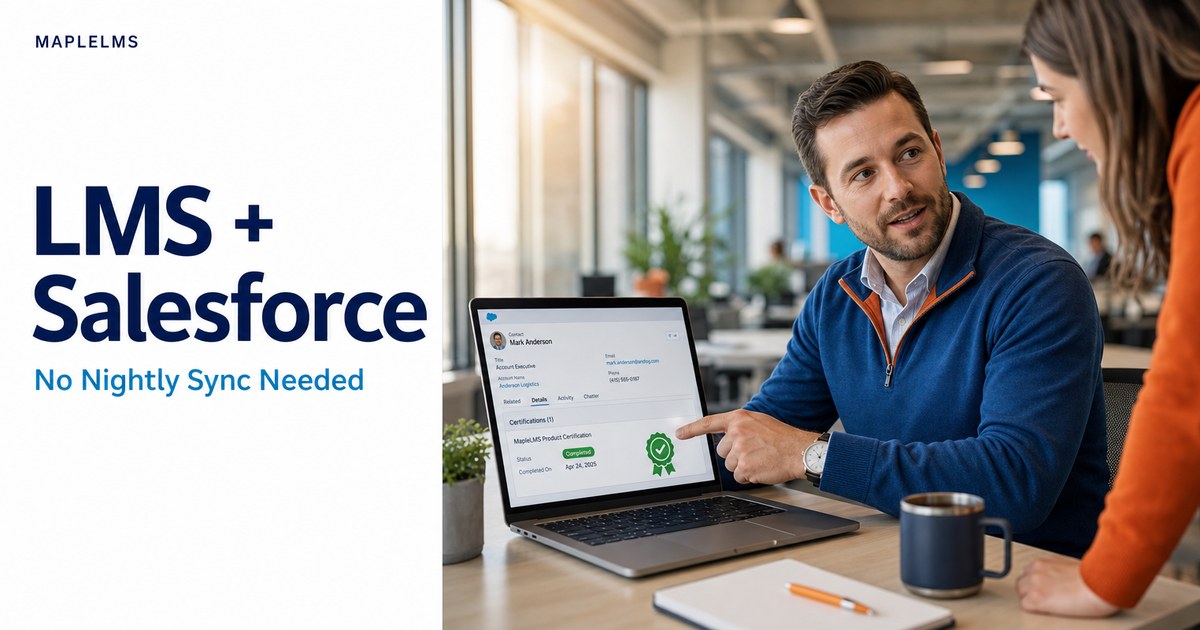
A corporate LMS is not a replacement for HR software or a Customer Relationship Management (CRM) system. It is a dedicated training layer that connects to those systems. When MapleLMS runs as a Salesforce-Native LMS, training data sits alongside pipeline and performance data inside Salesforce. A sales leader sees certification status next to territory performance in one screen, not two applications.
Our data: MapleLMS Cornerstone migration case study data shows administration effort for a 150,000-learner multi-region programme dropped by 35%, and training completion rose from 68% to 91%.
A cloud-based Learning Management System (LMS) manages hosting, automatic software upgrades, security patching, disaster recovery, and storage scaling on the vendor's infrastructure. An in-house deployment leaves every one of those tasks to the organisation's IT team, including the cost and labour of each server refresh and patch cycle. Cloud delivery also means every learner in every geography accesses the same updated platform without VPN tunnels or maintenance windows.
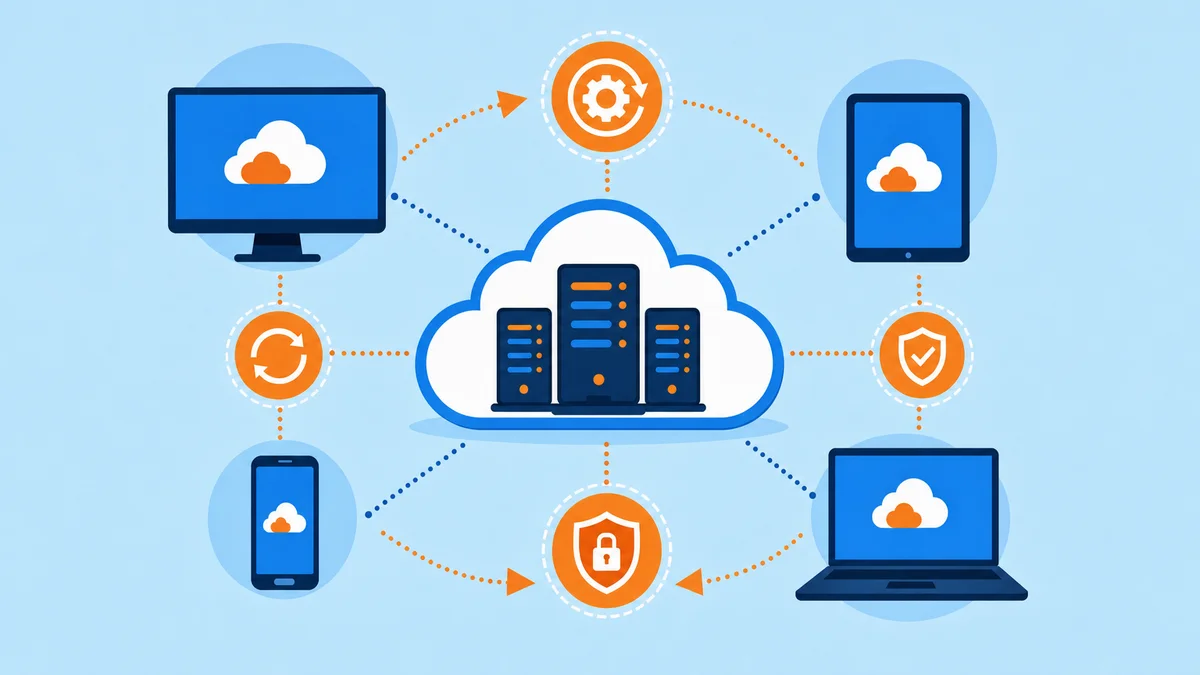
| Responsibility | Cloud LMS (vendor handles) | In-house LMS (you handle) |
|---|---|---|
| Server hardware and capacity | Vendor | IT team |
| Software upgrades and patches | Vendor, automatic | IT team, scheduled |
| Security monitoring and patching | Vendor | IT team |
| Disaster recovery and backups | Vendor | IT team |
| Storage scaling as learner count grows | Vendor | IT team, with procurement |
| Global content delivery | Vendor CDN | IT team, regional servers |
| 24x7 support | Vendor (when included) | Internal helpdesk |
Software-as-a-Service (SaaS) is a subscription delivery model where the vendor hosts and maintains the application, removing server management from the customer's IT team. Not every cloud LMS subscription covers the same services. MapleLMS's SaaS model includes hosting, unlimited storage, all software upgrades, maintenance, and 24x7x365 global support at no additional cost. Some platforms charge separately for storage overages, major version upgrades, or after-hours support. When evaluating a cloud-based LMS, the question is not only the per-user price. It is the all-in annual cost once support, storage, and upgrades are added.
SOC 2 Type II is an independent audit standard issued by the AICPA (AICPA, 2024) confirming that a vendor's security controls operate effectively over time, not just at a single inspection point. MapleLMS holds SOC 2 Type II and ISO 27001 certification, with data stored on Amazon Web Services (AWS) infrastructure and disaster recovery protocols in place. For regulated industries, those certifications reduce the security questionnaire burden during procurement and simplify IT security reviews.
A Sharable Content Object Reference Model (SCORM) compliant LMS can receive, launch, and record pass or fail data from any SCORM-packaged course, regardless of which authoring tool produced it (ADL, 2024). This means an existing course library works in a new platform without rebuilding every course. Experience API (xAPI) extends what can be tracked: offline mobile completions, on-the-job tasks, and activities outside the LMS, stored in a Learning Record Store (LRS).
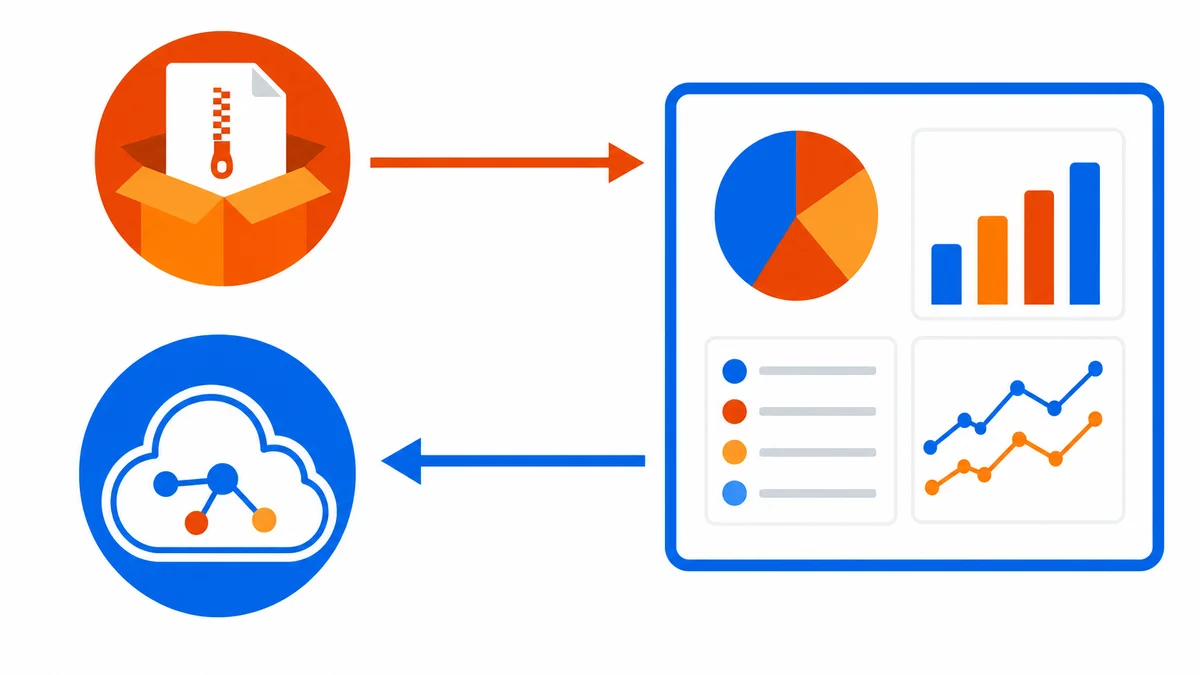
SCORM is a specification that wraps course content into a self-contained package with a standard set of communication rules. Any SCORM-compliant LMS can launch that course and record whether the learner passed or failed. SCORM has been the default for corporate training for more than two decades. Most existing course libraries are already in SCORM format.
Experience API (xAPI) (also called Tin Can API) records learning events as simple "actor, verb, object" statements (ADL, 2024). A Learning Record Store (LRS) is a database that stores xAPI statements from any source, inside or outside the LMS, capturing a complete record of learning activity across systems and contexts. An xAPI statement might record that a specific learner completed a product safety video on mobile while offline. That entry goes into the LRS rather than only the LMS, capturing activity on-the-job, in simulations, and in coaching conversations.
Yes, and most organisations use both standards at the same time. Here is why:
MapleLMS supports both SCORM and xAPI. Organisations can run their existing SCORM library while publishing new content in xAPI format and capturing offline mobile completions from field reps in areas with limited connectivity.
SCORM compliance protects your content investment. If you change your LMS, your SCORM-packaged courses move with you. Any compliant platform can receive them. In a documented MapleLMS migration covering 150,000+ learners, courses, learning paths, certifications, completion history, compliance records, and assessments all migrated intact, including the SCORM content library.
Real learning management system examples go well beyond compliance courses. Companies use a corporate LMS for new-hire onboarding, field-force launch readiness, partner and distributor enablement, customer product training, certification renewal tracking, and multi-region training with separate branded portals. MapleLMS Cornerstone migration case study data shows training completion rising from 68% to 91% and administration effort dropping by 35% across a 150,000-learner global deployment. The common thread is automation replacing manual assignment and reporting.
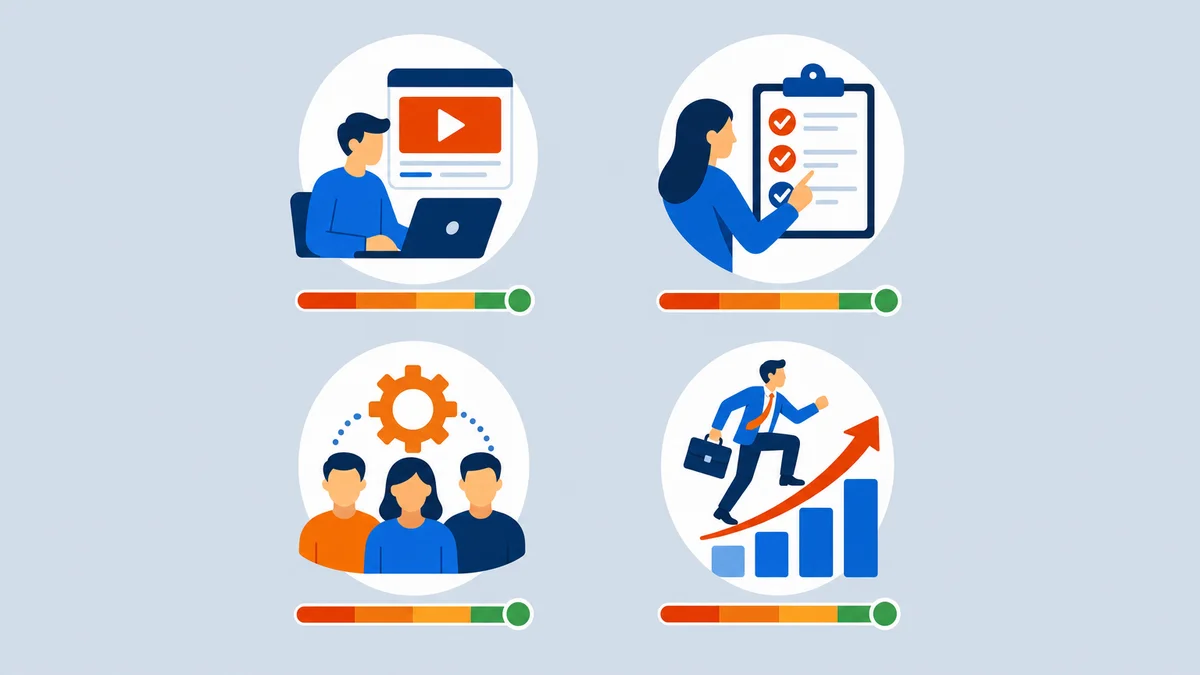
Our data: MapleLMS case studies show training completion rising from 68% to 91%, learner engagement up 42%, and compliance tracking time dropping from 5 days to under 1 day in a single life sciences migration of 150,000+ learners across North America, Europe, and APAC.
CMAX, an Australian early-phase clinical research organisation, needed to manage mandatory FDA, GxP, and HIPAA training for approximately 500 internal employees and external users. Before implementing MapleLMS, stakeholders had no real-time visibility into learner progress or compliance status. After implementation, MapleLMS data shows CMAX achieved 86% user adoption. Competency-linked course assignments aligned to each role's regulatory requirements. A Salesforce integration synced progress, completions, certifications, and records in real time.
This is a direct example of how a corporate LMS replaces spreadsheet-based compliance tracking with a system that surfaces gaps before an audit, not during one.
Casa Pharma Rx, a 503A licensed compounding pharmacy in Stafford, Texas, used MapleLMS for role-based product training across its sales and customer-service teams. MapleLMS data from the Casa Pharma Rx deployment shows 96% user adoption, with mobile-accessible, role-based training delivered with no prior LMS infrastructure in place. The example shows that a corporate LMS is as useful for product knowledge and sales readiness as it is for regulatory compliance.
An anonymised life sciences organisation migrated from Cornerstone OnDemand to MapleLMS across 150,000+ learners in North America, Europe, and APAC. The results from that documented MapleLMS deployment:
| Metric | Before MapleLMS | After MapleLMS |
|---|---|---|
| Training completion rate | 68% | 91% |
| Learner engagement | Baseline | +42% |
| Compliance tracking time | 5 days | Under 1 day |
| Reporting turnaround | 2-3 days | Real-time |
| Certification visibility | Limited | Centralised |
| LMS administration effort | Baseline | -35% |
The Pharmacy and Poisons Board of Kenya, through the PQM+ programme, used MapleLMS to scale regulatory training for pharmaceutical professionals. Outcomes included centralised and personalised learning, increased collaboration, and more efficient reporting and analytics across a distributed learner population. A cloud-based LMS handles the infrastructure complexity of national or multi-country training. The client organisation does not need to maintain servers in each location.
In life sciences and consumer packaged goods (CPG), a product launch is a compliance event as much as a commercial one. A corporate LMS assigns certification training by territory, product, and role. It confirms completion before launch day and gives commercial leaders a real-time readiness view. When that view sits inside Salesforce, certification status appears next to pipeline data. The sales leader sees readiness and opportunity in one screen, without switching systems or waiting for a manual export.
Modern Learning Management System (LMS) capabilities worth evaluating include private AI for course generation and smart grading, a Learning Experience Platform (LXP) layer for personalised learner journeys, AI-powered online proctoring for defensible certification credentials, and a built-in authoring tool that removes dependence on external vendors for content updates. Each capability earns its cost only when it removes a specific administrative step or closes a measurable gap in learner engagement or compliance evidence.
Private AI is an artificial intelligence layer that operates inside the LMS vendor's secure environment, using the organisation's own data, without sending content to public large language models. MapleLMS's Private AI features include AI course generation, AI roleplay simulations, smart grading, and AI-driven content curation. All operate within a SOC 2 Type II certified framework where data is never used for external model training.
This matters most in regulated industries. A life sciences company cannot afford to have clinical IP or unpublished product data processed by a public AI model. Private AI removes that risk while giving L&D teams the speed and scale of automated content creation.
A Learning Experience Platform (LXP) is a learner-facing layer that provides personalised, adaptive learning journeys and content discovery beyond a standard course catalogue. Where a traditional LMS pushes assigned training to learners, an LXP layer lets learners pull content based on skill goals, role, and learning history. Organisations with large, diverse workforces use an LXP to increase voluntary learning engagement without dismantling the compliance structure the LMS manages.
AI-powered online proctoring monitors exam sessions to detect suspicious behaviour, making certification credentials defensible if challenged in an audit or legal proceeding. For regulated industries where a certification is a compliance requirement, an unproctored exam creates a gap in the audit trail. MapleLMS includes an Online AI Proctoring module for exactly this use case.
Most LMS platforms require a separate authoring tool to create or update SCORM courses. Every time a product changes or a policy updates, content must go to an external vendor or be rebuilt in a separate application. A built-in authoring tool inside the LMS lets L&D teams update and republish SCORM courses without an external dependency. That matters most when product launches are frequent or standard operating procedures change on short notice.
A corporate Learning Management System (LMS) is not the right tool for every training problem. Organisations that need Standard Operating Procedure (SOP)-triggered retraining embedded inside document control or corrective and preventive action (CAPA) workflows need a dedicated Electronic Quality Management System (eQMS) for those functions. A Salesforce-native LMS integrates with an external eQMS to receive retraining triggers, but it does not replace document control or CAPA.
These are not weaknesses unique to one platform. They reflect functional boundaries: between an LMS and an eQMS, between a training delivery system and a content library, between cloud SaaS and on-premise infrastructure. Knowing where that boundary sits prevents a mismatched purchase.
A Learning Management System (LMS) is a software platform that delivers, tracks, and reports on training programmes across an organisation. A real example: a life sciences company with 150,000+ learners migrated from Cornerstone OnDemand to MapleLMS and saw training completion rise from 68% to 91%, compliance tracking fall from 5 days to under 1 day, and reporting move from 2-3 days to real-time across North America, Europe, and APAC.
A corporate LMS handles employee onboarding, product training for sales and customer-service teams, partner and distributor enablement, certification tracking with automatic renewal reminders, and field-force readiness. In one documented MapleLMS deployment, a compounding pharmacy used a corporate LMS for role-based product training and reached 96% user adoption across its sales and customer-service staff, with no prior LMS infrastructure in place.
A Sharable Content Object Reference Model (SCORM) compliant LMS can receive, launch, and record completion data from any SCORM-packaged course, regardless of which authoring tool created it. SCORM compliance means your existing course library works in a new platform without rebuilding every course. xAPI (Experience API) extends this by capturing learning activity outside the LMS, such as offline mobile completions and on-the-job tasks, stored in a Learning Record Store (LRS).
A business typically needs a Learning Management System when manual training tracking creates compliance exposure, onboarding is inconsistent across locations, or certification renewals are managed in spreadsheets. Organisations with distributed workforces, regulated roles, or multiple learner audiences reach this threshold faster. There is no fixed headcount rule, but the administrative burden becomes visible well before 500 learners.
A cloud-based LMS manages hosting, automatic software upgrades, security patching, disaster recovery, and storage scaling on the vendor's infrastructure. An in-house system leaves each of those tasks to the organisation's IT team. Cloud delivery means learners in any geography access the same fully updated platform without VPN tunnels or server maintenance windows.
A Salesforce-Native Learning Management System runs entirely within Salesforce infrastructure using standard Salesforce objects and permissions, so training data lives beside CRM pipeline data with no external database to maintain. A standard LMS integration connects two separate systems via a sync connector, which requires ongoing maintenance and can produce mismatched records between the LMS and Salesforce.
A corporate Learning Management System does four things no other system was designed to do. It assigns training automatically by role and region. It tracks completion and pass or fail at the individual level. It issues and renews certifications. And it produces compliance reports on demand, as of October 2026, without manual exports or spreadsheet reconciliation.
Real deployment results show what that looks like in practice. Training completion rising from 68% to 91%. Compliance tracking falling from 5 days to under 1 day. Administration effort dropping by 35% across a 150,000-learner global deployment. User adoption reaching 86% at a clinical research organisation and 96% at a compounding pharmacy.
Cloud delivery removes the infrastructure burden. SCORM compliance protects your existing content investment. xAPI extends what you can track. Modern capabilities including private AI, an LXP layer, AI proctoring, and built-in authoring each remove a specific administrative step when the problem fits.
If the operational pain points in this guide match what your team is experiencing, the existing MapleLMS overview of LMS use cases covers additional scenarios. When you are ready to see a live deployment, book a demo with MapleLMS.
Coming soon in this cluster: